
The Phantom Reciprocity — when what we call intimacy might not be

There’s a sentence I received one evening, in a relationship that mattered deeply to me.
We’d just had one of those rare conversations — the kind where, for once, I was putting something of myself on the table. Nothing dramatic. Just that I wasn’t doing well. That I’d been carrying something heavy for a while. That I could have used, just this once, a little space to not be the one holding things together.
Her response was short. Almost gentle in tone. Devastating in substance:
“You can’t be struggling. You’re my rock.”
I stayed silent. Not out of strength. Out of shock.
That evening, I understood something I wouldn’t have been able to articulate back then — but that I want to try to name here. Because I believe many of you are living it, on one side or the other, without having the words to see it clearly.
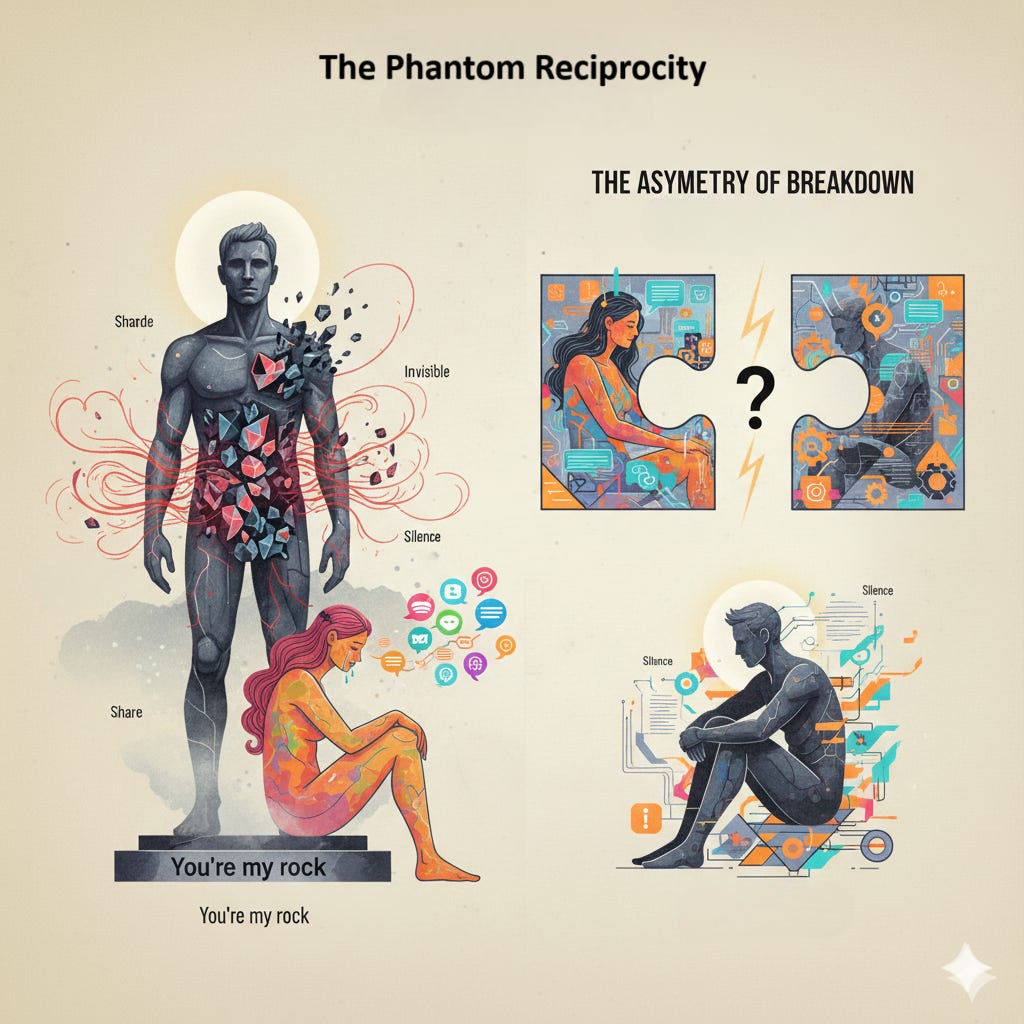
What I had built without realizing it
For months in that relationship, I occupied a very specific position: I was the one who held things together. She was going through a difficult period — workplace tensions, exhausting power dynamics, relational situations that regularly pushed her to her limits. She needed to be heard, reassured, supported. I was there. Fully.
What I couldn’t see was that in this configuration, there was no room for me to also have days where the floor dropped out. Not out of any ill intent on her part — by structure. I had gradually, without ever consciously deciding it, accepted the role of permanent container.
My own withdrawal didn’t look like tears or words. It looked like hours at the gym, miles of running. Searching in physical effort for what I had nowhere else: a space where I could set down what I was carrying, without someone needing something from me at the same time.
I was gaining physical strength. I was losing interior space.
The sentence that revealed everything
When I finally asked for my own place — not much, just to be seen in my fragility too — the response I received taught me something essential about what we call reciprocity.
“You can’t be struggling. You’re my rock.”
It wasn’t cruelty. It was panic. The panic of someone whose entire internal security system rested on my stability. My fragility wasn’t just uncomfortable for her — it was structurally unacceptable, because it threatened the equilibrium we had co-built.
And there it was, staring me in the face: this wasn’t a relationship between two adults supporting each other. It was a configuration where one carries, and the other is carried. Indefinitely. With no rotation possible.
That isn’t reciprocity. It’s something else entirely.
What reciprocity actually means
Most of us think of reciprocity as a symmetry of form: I open up, you open up. I cry, you cry. I give, you give.
But real reciprocity is a symmetry of position: can each person, in turn, be the one who breaks down — in their own language, not necessarily in mine?
And this is where something quietly unravels in many relationships. Because breakdowns don’t look the same.
When she needs connection, it often looks like words, named emotions, a request for verbal and affective presence. It’s visible. It’s recognizable. It naturally activates the other person’s compassion.
When he needs connection — or when his system is saturated — it looks like silence. Withdrawal. A disappearance into activity, work, sport, a screen. Sometimes irritability with no apparent cause.
If the only breakdown recognized as legitimate is the one that speaks in words, then the other breakdown — the one that goes quiet, that retreats, that disappears — will always be misread. It will be interpreted as rejection. As fear of intimacy. As a refusal to connect.
And in that interpretation, something essential vanishes: the possibility that he, too, is breaking down — just in a language that goes unrecognized.
What internal systems accumulate
Richard Schwartz, through his IFS model, describes something useful here. Inside each person coexist different “parts” — aspects of the self that play different roles depending on the context. Some parts protect and hold space. Others carry the deepest wounds, the most vulnerable needs.
In a man structurally positioned as a container, what happens gradually is this: his vulnerable parts are systematically pushed back so that his protective parts can keep holding. For months. Sometimes years.
Those vulnerable parts don’t disappear. They accumulate. And that accumulation eventually surfaces — as sudden withdrawal, unexplained irritability, or an abrupt collapse that surprises everyone, including himself.
I know this from the inside.
The sport wasn’t a passion. It was a pressure valve. And the day even the valve wasn’t enough anymore, I asked for my place. And I was told I didn’t have one.
The invisible mechanics: two stories, one reality
Paul Watzlawick described what he called the punctuation of sequences: in any interaction, each person perceives the sequence from a different starting point, generating two incompatible narratives — both subjectively true.
She says: “I open up, he shuts down. He’s afraid of intimacy.”
He says: “She breaks down, I absorb, she never holds space for me. So I withdraw.”
Each sees the other as the cause of the problem, because each starts reading the sequence from a different place. Neither is lying. But the dominant punctuation — the one that designates who is wrong, that pathologizes the other — always conceals something deeper: a structural asymmetry in the positions occupied. Not in the intentions.
What I learned from the other side
I have also been, in other relationships, the one who pursued. The one who asked for more presence, more openness, more connection.
And with hindsight — the kind that comes from inner work, from reading, from being accompanied — I saw what was hiding behind that demand. It wasn’t only a desire for intimacy. It was also a need for reassurance. An underlying anxiety looking to regulate itself by gathering evidence that the other person was there, that I mattered, that I wasn’t going to be abandoned.
The demand looked mature. It spoke the language of connection, vulnerability, authenticity.
It was also, in part, serving to soothe something in me that hadn’t yet found another way to stabilize itself.
I’m not saying this to generate guilt in anyone. I’m saying it because it’s true — and because seeing it clearly, honestly, without self-flagellation, might be the beginning of something different.
A question worth sitting with, without judgment
What I’m trying to name in this article isn’t a fault. It’s a structure. A configuration that installs itself gradually, often without either person consciously choosing it, and that ends up exhausting both partners — one through silent accumulation, the other through a demand that can structurally never be fully met.
So here is a question — not to condemn yourself, but to see more clearly:
When he breaks down in his own language — the silence, the withdrawal, the exhaustion, the disappearance into an activity — do you meet it with the same patience you expect from him when you break down in yours?
If the answer is no, that’s not a reason to judge yourself. It’s information.
And perhaps the most important information this series can offer you.
What remains open here is an even harder question: if these structures are so difficult to see from the inside — because they look like love, because they speak the language of maturity, because they build so gradually that you don’t notice them taking hold — what actually allows them to shift, without waiting for the other person to change first?
That’s what the next articles explore.
Great article, I’ve realized that many men in my life couldn’t articulate their needs and instead went to the gym, feeling irritated. From my side, I felt that they weren’t opening up, and I wanted more action and openness from them. But what I’m learning now is that it’s really about in-the-moment communication. It’s not something I’ve truly seen modeled in my life or inherited in any way. It’s a learning process, and it’s great to see you writing about it from a man’s perspective.
Truly a great article. It resonates in many ways with my own experience. It describes both perspectives very well without criticism or judgment.
I appreciate your contribution to making these dynamics visible and easier to understand.
Looking forward to the next article.