
The One Who Is Not Afraid

At first, she used to say what she wanted. Not always with conviction — she hesitated, beat around the bush, suggested two options at once — but she still said something. One restaurant rather than another. A beach vacation rather than the mountains. A way to organize the weekend.
He decided quickly. Not brutally — with that kind of quiet confidence that made his opinion hard to dispute. He didn’t force anything. He just suggested, firmly, and the conversation naturally stopped there. She agreed. It often seemed reasonable to her. And when it didn’t seem entirely reasonable, the moment had already passed.
After a few months, something had changed imperceptibly. When he asked “what do you want to do?”, she answered more and more often “whatever you want” or “I don’t really have a preference”. It wasn’t true. She had preferences. But she had learned, without realizing it, that expressing them opened a discussion that almost always ended up in the same place. So she started keeping them to herself — first to save energy, then out of habit.
What she didn’t say out loud was that this saving came at a cost. Every time she let a preference slide, something remained — not anger, not yet, but rather a quiet little accumulation. The kind of thing you can’t name because you wouldn’t know exactly what to call it. It was never serious. It was just there, underneath, like background noise that you eventually stop hearing but that is always present.
And then one Sunday, he asked her what she wanted to do for her birthday vacation. She said “doesn’t matter, you choose”. He insisted, gently: “No, really, tell me what you’d like.” She tried to answer — and realized she didn’t really know anymore. Not because she didn’t have desires. Because it had been a long time since she had actually consulted them.
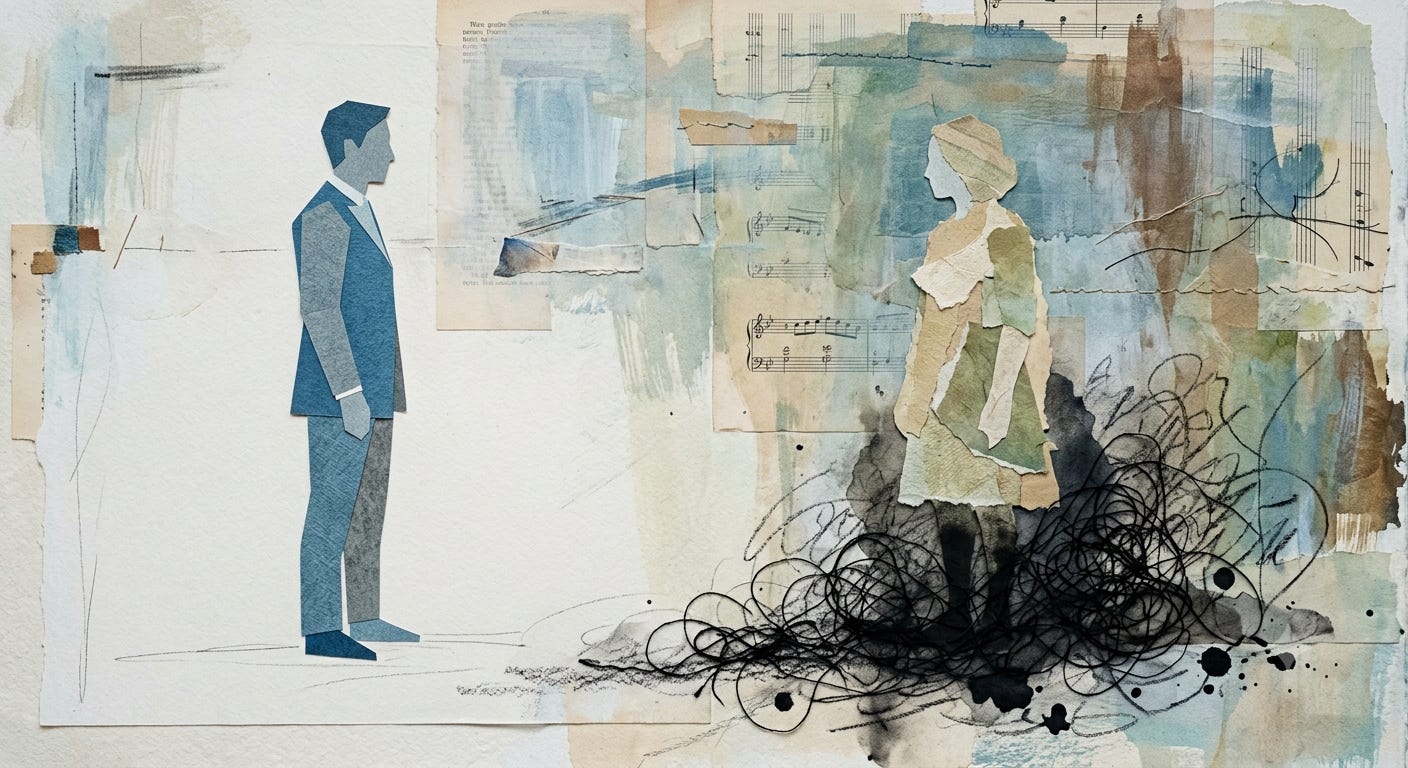
What happened in this couple has no obvious culprit. He never tried to take up all the space. He’s just like that — he decides quickly, he doubts little, or at least he doesn’t show it. What he took for efficiency, for a service rendered to a couple that doesn’t like hesitation, was actually something more unilateral: a way of taking up space without leaving the other person the room to truly exist in the decision.
Displayed self-confidence — the kind that never doubts, decides without hesitation, and “has no problem with that” — has a hidden side in a relationship. It creates a zone around itself where the other person’s doubt becomes difficult to express. Not because it is forbidden. Because it seems out of place, disproportionate, a bit burdensome in the face of such certainty. So the other person gives up on voicing it. First out of politeness. Then by reflex. And finally because they have lost the habit of consulting their own desires — which ended up eroding from not being asked for.
It isn’t submission in the brutal sense. It’s something softer and more insidious: a gradual shift where one partner becomes, without intending to, the center of gravity for all decisions, and the other a satellite adjusting around them. The decision is made together, on the surface. But only one person really carried weight.
In Transactional Analysis, we would speak of an “I’m OK, you’re less OK” position — unaddressed, never stated, but established through repetition. And what holds this position together, often, is precisely what we admire most in one of the partners: their strength, their calm, their visible lack of fragility. What looks like strength can also be a way of never having to show doubt — and therefore never giving the other person permission to do the same.
That evening, after the birthday vacation Sunday, she told him something simple: “When you decide so quickly, I feel like my desires don’t really have space anymore. Not because you refuse them — because we never get to them.” He was surprised. His certainty had always felt neutral to him, almost practical. He hadn’t seen that it was taking up space belonging to something else.
That evening, he said what he never used to say: “Actually, I hesitate on that too. I just don’t show it. But I’m not that sure.” It wasn’t much. It was just a crack intentionally left open — and in that space, she found room again to say what she really wanted. Not in reaction to him. For herself.
A truly shared decision, perhaps, isn’t the one where both agree. It’s the one where both had the room to disagree — and where each could say what they wanted before the choice was made.