
The argument started before you even got home.
And you weren’t even there.

You’re late. It’s been a long day, the meeting dragged on, you didn’t have a choice. You push the door open. And you feel it immediately—something in the air. Not a word, not a scene. Just a silence with a very specific texture. A turned back. A short, clipped answer to a mundane question.
You wonder what you did wrong.
But here is what they don’t tell you: the argument had already begun. Two hours before you walked in. Without you.
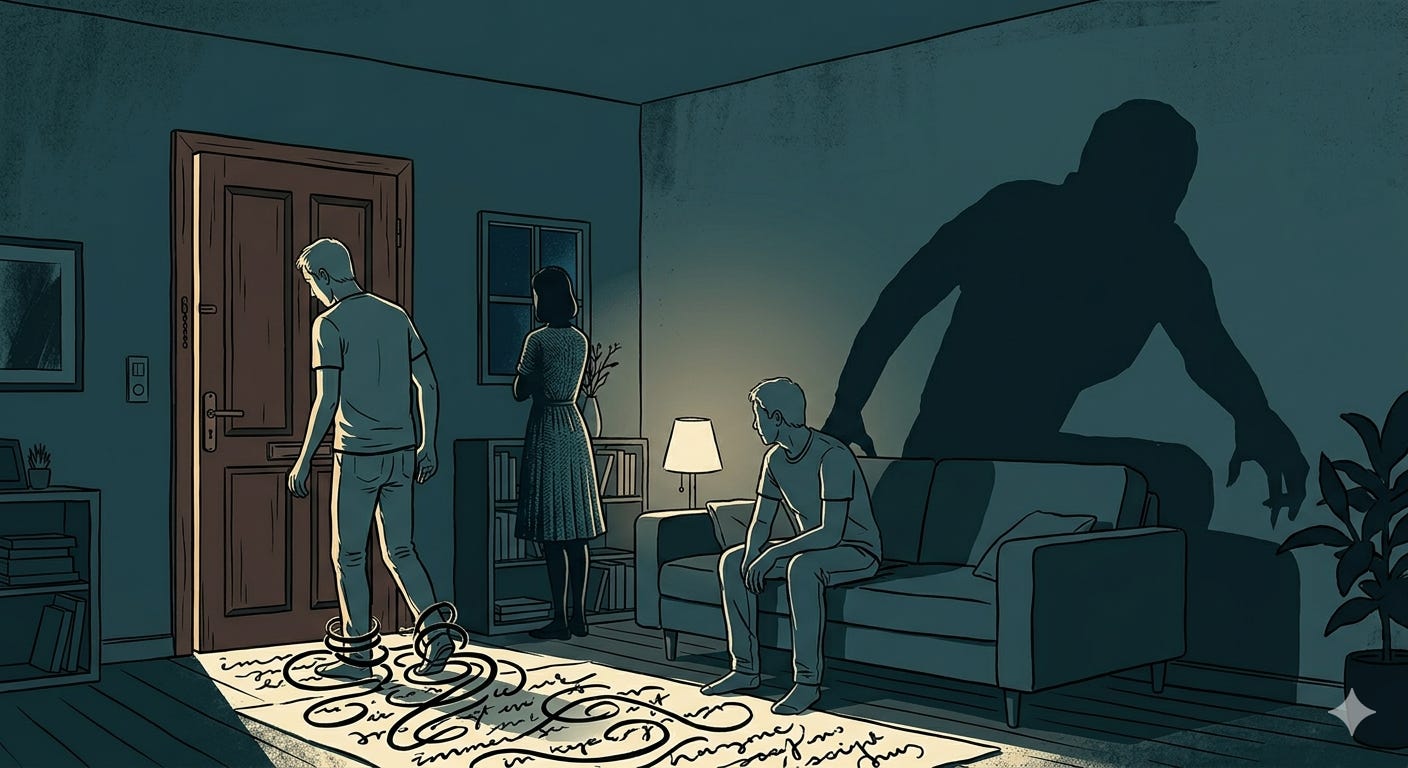
While you were in that meeting, your partner was managing. The end of the day, the kids, dinner—everything that piles up when you’re carrying the weight of the household alone. And at some point—not a specific moment, more like a slow accumulation—something shifted in their mind.
Not anger, not yet. More like a narrative. He’s late again. He puts his work before us. She doesn’t realize what I have to handle on my own. A story built piece by piece, in the silence of the apartment, while you were wrapping up your meeting, completely unaware that you were being judged as absent.
That is the mechanism. You settle into the role of the Victim before the other person even arrives. You write the script. And when the door finally opens, the partner doesn’t just walk into the living room—they walk straight into a role they’ve already been assigned.
And you, on your end, you feel the silence. And that silence does something to you.
Maybe it’s guilt. Maybe it’s annoyance—because you didn’t choose to be late, because you were just doing your job, because you shouldn’t have to answer for a meeting. Maybe it’s both at the same time, tangled up, impossible to untangle.
So you do what most people do in those moments: you defend yourself before you’re even attacked. “The meeting took longer than expected.” Or you attack first. “What’s wrong now?” Or you shut down, letting the coldness settle on both sides.
The Karpman Triangle has just closed its trap. One is the Victim—lonely, unacknowledged. The other is the Persecutor by default—accused of an absence they didn’t choose. And the evening goes by at a distance, over a silent dinner where no one says what is actually happening.
What makes this hard to see is that both sides have a point.
One really did manage everything alone. The exhaustion is real, the need for connection is real, the longing is real. The other really did endure a brutal day. Being late wasn’t a choice, the meeting wasn’t an abandonment.
But here is the question nobody asks: is what’s playing out that night really about that night?
Or does that silence, that specific texture in the air, carry something much older—a need for connection that was never truly stated, an expectation never spoken, a fear that the other person isn’t truly there, even when they are?
The trap of this scene is that it is rarely resolved within the scene itself.
You negotiate the lateness. You explain the meeting. You apologize, or you don’t. And the next day, everything seems back to normal. Until the next time.
Because what goes unsaid stays there. The unexpressed need for connection turns into resentment. The unspoken expectation becomes an obvious truth the other person should just get without being told. And bit by bit, the relationship builds itself on what each person assumes the other should know—rather than on what has actually been said.
Did you tell them that you need them to see you walk in, not just judge you as absent? Did you tell them that you need a moment to decompress before you can truly be present?
Not on the night of the argument. In a calm, low-stakes conversation, where both of you can actually hear each other.
The late-return scene isn’t a scene about schedules. It’s a scene about what we expect from the other without saying it—and about what we build, alone, in the silence, before they even get home.
What you are pretending not to know: that the story you told yourself during their absence, you wrote it yourself. And that they stepped right into it, without ever knowing it existed.
This scene is the second of the six I explore in Out of the Game—a book about ordinary psychological games in couples. Not quick fixes or recipes. A way to see from inside the mechanism—and to ask yourself what you are still doing there.
I hear you friend!! ❤️