
Instead of Jabbing

He comes home late, once again. She hears him put down his keys, take off his shoes, and she feels the ready-made phrase rising up—the one that would slip out effortlessly: “Oh, so you still remember where we live, that’s nice.“ A classic. It might get a smile. It would remind him, in a lighthearted way, that she’s been waiting for him, that she’s counting the hours, that she’s been a bit lonely since this morning.
She knows this phrase. She knows exactly where it would sting—not hard, just enough. And for some time now, she also knows what lies behind the urge to say it: not really anger, not a true reproach. Just a need to feel that he is here, right now, with her, and not yet with his phone or the television.
She doesn’t say the phrase.
She puts down her book, watches him walk into the room, and simply says: “I’m glad you’re home. I’ve had a bit of a lonely day, and I’d love for us to take ten minutes together before dinner.”
Nothing spectacular. No jokes, no double meanings, no little jabs to see how he reacts. Just what she actually wanted to say, said directly.
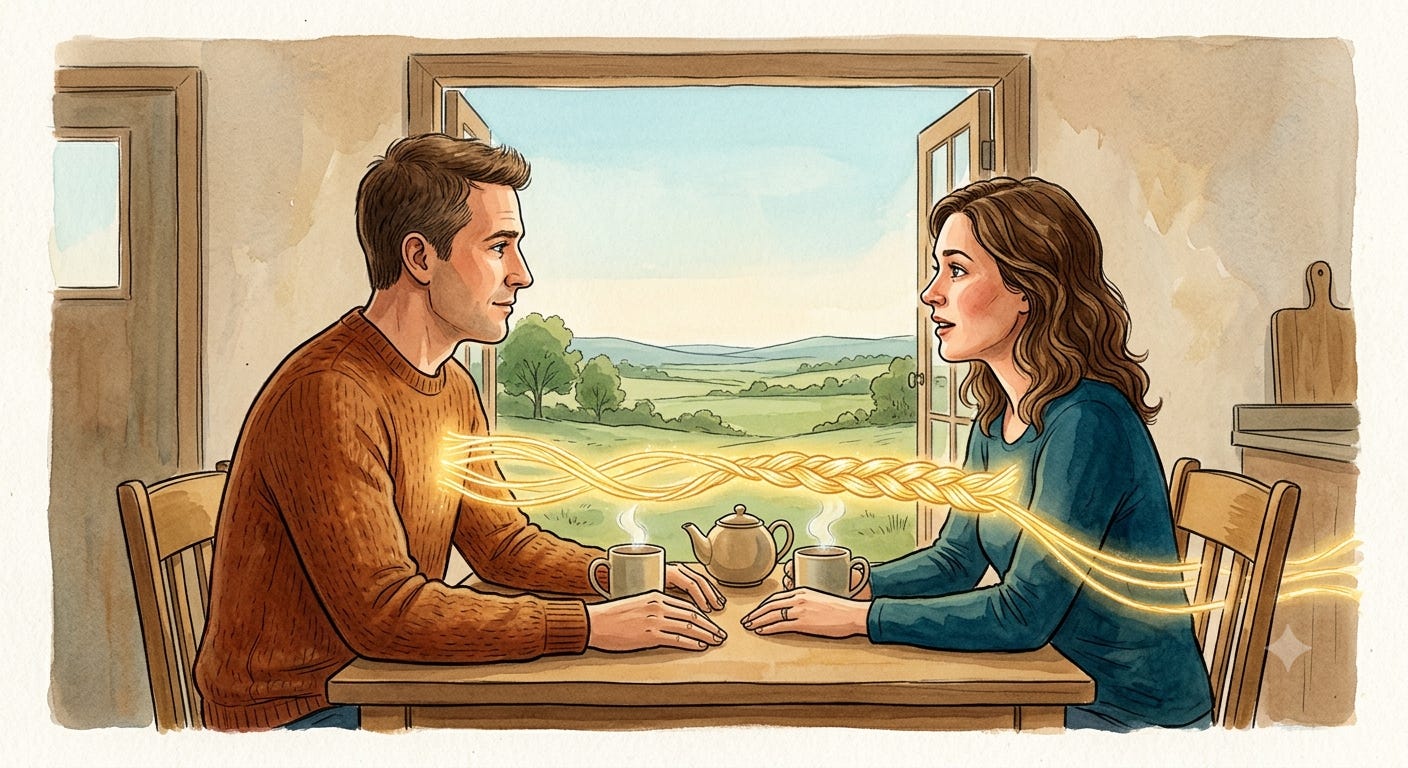
What happened in that single second of silence, before she opened her mouth, deserves a closer look—because that is exactly where, every single time, the choice between two different worlds is made.
The first reflex—the jab, so you still remember where we live—would have worked, in the sense that she would have gotten some attention, some reaction. It’s what we’ve seen before: a negative stroke is still contact, and contact, even when imperfect, is more reassuring than silence. But that contact would come at a quiet cost, paid in installments—a small dose of annoyance on his part, one more tiny habit to defuse later, and above all, no real information exchanged. He might have laughed, apologized vaguely, and the real thing—I need you right now—would have remained unsaid, hidden behind the humor used to carry it.
What she did instead is not a heroic act. It’s just more exposed. By stating what she feels directly, she takes a risk that the jab allowed her to avoid: the risk of being taken seriously, or not. He could answer, “I’m exhausted, give me five minutes.” That would be a real, immediate disappointment, without the protective filter of humor to cushion it. The jab offered an escape hatch—”it was just a joke”—that the direct statement no longer provides.
And that is precisely what this third path requires: accepting to stop hiding behind the game, even when the game is comfortable, even when it has always more or less worked.
Conversely, this doesn’t mean keeping quiet about what bothers you. A week later, it’s his turn to say something is wrong—she canceled a dinner at the last minute that they had planned for three weeks, choosing instead to go out with friends. The old reflex would be to let it slide, to say nothing just to keep the peace, and to let a small irritation settle in silently—the polite, almost invisible version of the same avoidance as the jab, just tucked away in the opposite direction. He chooses to speak up that evening: “I was disappointed that you canceled. We can talk about it later, but I’d really like us to find another night.” Not a reproach disguised as a quip. Not a simmering silence. Just what happened for him, stated without detours, and a proposal for what comes next.
Neither of them, in these two scenes, needed to jab the other to feel like they mattered. Neither needed to suppress what was important to maintain a surface-level peace. What changes isn’t the intensity of the bond—they still need each other just as much—it’s the way they express it. Above all, it’s the capacity of each person to carry that need without expecting the other to guess it through a joke or a heavy silence.
That is perhaps the true difference between depending on someone and caring for them. Depending means needing the other to react—even poorly, even with a jab—to feel connected. Caring for someone means being able to say what you feel while knowing you would stay standing, even if the response wasn’t the one you hoped for.
It isn’t easier. It’s just truer—and it removes a detour from the relationship that it never really chose in the first place.